In an office in North Beach, San Francisco, a programmer raises his hand in a meeting, not to discuss feature development, but to address a bug he just discovered. When he joined, the company gave him the title of “co-founder”—he is the 37th employee.
This is not an exception. At AI programming company Cursor, the first 50 employees were all given the title of co-founder. They spent a long time meticulously hiring the initial 10 people, but once on board, everyone is expected to think and act like founders. The office itself resembles a “public lounge and cafeteria of a university.”
This is the first layer of Cursor’s brand culture: redefining identity to flatten hierarchies and foster a sense of belonging. It feels less like a corporation and more like an elite campus. Most employees are in their mid-twenties, they take off their shoes when entering the office, often work late into the night, and shower at the office, living just a few blocks away.
CEO Michael Truell believes this system allows “every employee to be responsible for product direction.” The result is a record-setting growth in B2B SaaS, achieving “the fastest growth from zero to a billion dollars in annual revenue in just 17 months.”
University-like Collaboration: Driving Radical Iteration
This “university-like” atmosphere has led to a complete transformation in work methods. Its collaborative model is unconventional:
- Flat collaboration: Teams have no strict reporting relationships, and employees self-assign tasks.
- Meetings focus on bug fixes: Instead of lengthy process reports.
- All-hands recruiting: Employees part-time recommend talent, even scouting potential candidates from active Twitter users at night.
Loose? Quite the opposite; it has resulted in astonishing decision-making and iteration speed. The core output of this culture is a straightforward internal guideline: “overthrow the product.”
The release of Cursor 3 (codenamed Glass) epitomizes this philosophy. It is not just a feature update but a paradigm shift built from the ground up. It completely restructured the IDE interface that has been in use for 40 years: the traditional file tree display was replaced by an agent command input box; the conventional code editor was relegated to a secondary position, with the main interface becoming an agent management console.
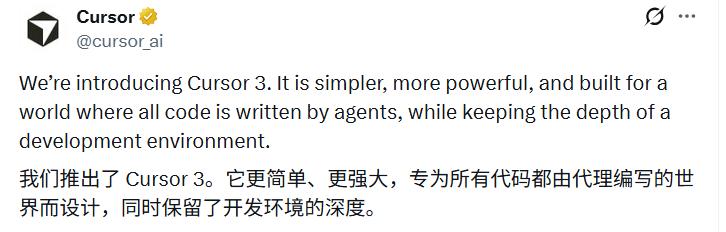
This means that developers’ core work has shifted from “writing code line by line” to “orchestrating agents and reviewing outputs.”
Why such radical changes? Because competitive pressure is imminent. Giants like OpenAI and Anthropic have launched similar products like Claude Code, aggressively competing for users with substantial subsidies. Cursor realized that its business model as an external large model “purchaser” was losing its moat.
Thus, they completed a strategic shift from “auxiliary tools” to a “multi-agent operating system” in just six months.
Young Team’s Pragmatism: Balancing Innovation Speed with Commercial Sustainability
Founded by four MIT dropouts from the 2000s, the team’s technical decisions reflect generational traits and pragmatism.
They did not fall into the blind investment of a “GPU arms race” but took a flexible approach:
- Early stage: Directly utilized top external models like Claude and GPT to quickly validate product-market fit.
- Later stage: Initiated in-house development, fine-tuning and reinforcing learning based on powerful Chinese open-source models (like Kimi) to create the Composer series of proprietary models.
- Results: Their in-house developed Composer 2 model scored 61.3 in internal testing, even surpassing Anthropic’s top model Claude Opus 4.6 (58.2 points).
This pragmatism is also evident in their growth strategy: accumulating millions of developer users through free tools to build reputation and network effects; then achieving profitability through enterprise versions (which cover 64% of Fortune 1000 companies), supporting strategic losses in personal business for growth.
Halo and Shadows: Cultural Challenges Amidst Rapid Growth
This extreme culture has shaped the myth of Cursor as “the fastest-growing startup in history,” but it also brings unique challenges.
- Positive feedback: The developer community praises its product iteration speed, stating there are “substantial updates almost every two weeks,” and the smooth experience of multi-file editing.
- Negative feedback: The aggressive iterations have raised concerns about stability. Some enterprise users have turned to competitors due to compatibility and speed issues, and discussions of “Cursor is dead” have emerged in the community. A survey showed that 46% of developers listed Claude Code as their favorite tool, with Cursor in second place at 19%, indicating fierce competition.
An investor once pointed out a paradox: “Cursor’s data shows no signs of anything other than complete success,” yet the most sensitive group of developers in the industry has begun to express collective unease. This reveals a deeper characteristic of its culture: it serves the efficiency of ‘disruption’ and ‘growth,’ which can sometimes clash with the enterprise-level demands for ‘stability’ and ‘predictability.’
The story of Cursor goes beyond the myth of four 2000s dropouts creating a $60 billion valuation. It showcases a new organizational and product philosophy driven by a young team: stimulating extreme autonomy through identity recognition, agile responses to bureaucracy with a ‘university-like’ approach, and facing sudden shifts in technological paradigms with the courage to ‘overthrow oneself.’
Its culture is both the engine of its rocket-like growth and the most tension-filled challenge it must navigate in the future.
Comments
Discussion is powered by Giscus (GitHub Discussions). Add
repo,repoID,category, andcategoryIDunder[params.comments.giscus]inhugo.tomlusing the values from the Giscus setup tool.